
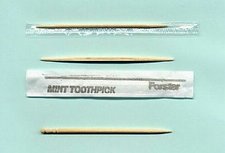
 In the 1860s, Charles Forster did something pretty remarkable with an object many people considered ordinary. The object was the toothpick, and what Forster managed to do was get people who would never have been caught dead with one to use this sliver of wood to pick their teeth outside swanky restaurants, hold it in their mouths, and use it in a variety of other venues that at first glance appeared very un-toothpick like.
Now, history never repeats exactly, as much as the old cliche would have us believe anyway, but the themes of history — thanks to the habits of we humans — will continue to play and replay themselves until the end of time (or humans, which will undoubtedly come first). In that vein, the Wii is a toothpick, and it’s about ready to blow the hell up.
I think before we go any further a history lesson is in order, because the parallels between the toothpick industry’s humble beginnings and what’s going on and will happen in video games are too uncanny to ignore.
When ol’ Forster first got the bright idea that toothpicks needed to be mass produced, it was while working for his uncle’s business in Brazil. In the land of beach volleyball and string bikinis (well, that’s today, not then) he noticed that the Brazilians had beautiful white teeth. To get these teeth, he surmised, the Brazilians used a host of their handcrafted toothpicks. At this point int time, Forster vowed to make his fortune by producing wooden toothpicks cheaply by machine to the tune of millions per day.
It’s at this point where we see the first of many significant parallels between what the Wii is accomplishing today in video games, and what the toothpick would accomplish in the 1860s and 70s with “traditional views” on how and when to use toothpicks.
By 1870, Forster’s operation was capable of producing millions of toothpicks per day. Unfortunately for him, there was no market for his mass produced toothpicks in Boston, his home, and these millions of slivers of tooth picking wood went to waste. Why was there no market? Because of tradition. People didn’t want cheap, mass produced toothpicks made from everyday wood, they wanted hand carved masterpieces whose techniques had been passed down from generation to generation in fine Yankee tradition. At least that’s what they thought they wanted. Do you see the first parallel yet?
The thing is, Forster knew he had a great idea on his hands and better yet, it was a useful idea. People just needed to be shown that — as is often the case with tradition — a new, better implemented idea had come along to make life easier and, yes, even though we’re talking about a low technology toothpick, was more fun.
So he got shifty. And I mean really shifty. And here is also where we find the second parallel: marketing.
If you look back at Infendo’s coverage in 2006, you’ll find a wealth of information on the Wii Ambassador parties. These events, a first for the industry as far as I know, saw Nintendo randomly contacting bloggers, gamers, mothers, groups, media types and everyone in between about the prospect of setting up a party with the Wii as the guest of honor. Those that accepted the invite were treated to food, party favors and of course, access to the Wii and a good sampling of its launch library. These parties, for the most part, were “televised” by the people who threw them, not Nintendo, and the overall impression the public received was that they had free reign over the systems with very little input from Nintendo (no pictures were allowed, however). Instead of inundating these people with press releases, Nintendo allowed the system to speak for itself. One mother I interviewed about this, Tracey Clark, couldn’t even remember the names of the games — she only recalled how fun they were, how intuitive the motion sensing was, and how much her children loved the system. So much for the “power of the brand,” eh? Without so much as a soft sell from Nintendo reps at the party, Clark said every one of the 30 or so people there that day said they were 100% buying a Wii. Forster did the same. He didn’t advertise, he marketed. There were no crying baby dolls with toothpicks in their hands; or loud, obnoxious toothpick-themed soft drink campaigns; there was just word of mouth, which he manufactured.
When Forster first started looking at new marketing approaches for his failed toothpick business, he targeted stationers, who dealt in small items. When they said no, he hired “personable young people” (read: hot and intelligent) to go to those same retailers and ask for wooden toothpicks. Naturally, the retailers had none to sell. Immediately afterward, Forster return to the targeted store and the merchant would greedily snatch up everything he was selling. Forster’s minions would then return to the store to ask again for toothpicks, and a sale was made to solidify the trend.
But that was only the beginning. For restaurants, Forster hired “Harvard men” (this was Boston). After dining at a local haunt, such as the Union Oyster House (which I was just at the other day, and I got a toothpick on my way out), they demanded toothpicks. When none were made available, they raised a ruckus and threatened to forgo that restaurant on their next night of blue blood mastication. When Forster came by the next day selling his wares, the restaurateur was all to eager to stock his hostess stand with the cheap, mass produced toothpicks.
Nintendo has done the same with both of their signature consoles, the DS and the Wii — although not as shadily as Forster. They created the buzz with the Ambassador Parties, and let the consumers drive demand — as business should be — instead of letting tradition or an established brand dictate what people want. UPDATE@3:30 EST: More proof that Nintendo is relying on word of mouth over advertising: “Citing research firm Nielsen Monitor-Plus, the MediaPost report said Nintendo spent $40 million in print, TV and outdoor media the first half of 2007, and $87 million and $84 million in 2005 and 2006, respectively.” Word of mouth is more trusted by consumers. If you do it right, no amount of advertising can compete with it. — j.l.
And did I say that was only the beginning? I was wrong, this was only the beginning, because a crazy thing happened next. As people started using the low cost toothpicks for their intended purpose — picking teeth — the little slivers started to transcend mere hygiene. It’s a term called “usage drift,” and it happens in every industry, not just the ones that involve removing stuck food from between teeth. This includes video games, and what I envision will happen with the Wii and DS.
Slate (from where this research was pulled):
Chewing toothpicks in public soon became fashionable among well-to-do men, and after a while young women began taking up the practice. One Bostonian observed that at lunchtime “nearly every third woman met in the vicinity of Winter and West streets has a toothpick between her lips.” This ostentatious primary and secondary toothpick usage in the 1870s served to further the general desire for toothpicks.
It was a common observation of the time that many of the young men standing in front of a good hotel chewing toothpicks were suggesting they had eaten in its fine dining room, when in fact they could not afford to do so. In time, chewing a toothpick anywhere became a sign of contentment and insouciance. In his Life on the Mississippi, Mark Twain described feeling that he knew the river so well that he found himself cocking his cap and “wearing a toothpick” while at the wheel of his riverboat.
Slate also notes that “the toothpick took on a life of its own, serving not only as a utilitarian object but also as a status symbol and even as an accessory. While Charles Forster may never have dreamed that his toothpicks would have such unintended ancillary uses, he would no doubt have welcomed them as extensions of his initial marketing efforts.”
My my my. Another parallel. In today’s mainstream media, we see the Wii being compared to everything from an exercise machine to a dementia fighting tool in assisted living homes to a rehabilitation device that can revive the will of cancer survivors. Mariners fans are ordering $10 hot dogs at Safeco Field and Japanese museum visitors are accessing information on painting wireless on their DS. And all the while these people are actually playing subsets of video games! Surely Nintendo knew that its little white devices had some potential to reach out, but I doubt even they knew the full extent of what’s happening (and will happen). Case in point, the hardware shortages. Both systems have seen them (Wii all of 2007, DS following Xmas 2006).
The PS3’s Folding@Home might be grouped into usage drift at first glance, but one could then argue that while the Wii is exploring wild new areas not originally conceived by Nintendo, they are all still wild new areas rooted firmly in actively gaming. Folding@Home, while remarkable, is still just an idle PS3 being a supercomputer. The user is an irrelevant piece of that picture who exists merely to hit the power button. The same goes for multimedia functionality. Most users today already have several devices capable of such things that do it for a lower price point and usually with better quality.
The PSP could also be looped in here. But Jack, you might say, it has MP3 playback, movies and can surf the Net! Truly, it can, but there’s a catch with usage drift.
Though readily promoted by manufacturers, usage drift is more often created by consumers of a product. People are natural inventors, and they are constantly finding new uses for common objects of all kinds. The best ideas propagate quickly through the culture and then become embraced by manufacturers as their own. Before there were Q-tips, young mothers wrapped a bit of cotton around the point of a toothpick and used it to clean out baby’s ears and nose. This practice came to be recommended by ladies’ magazines and advice columnists, and led to the invention of the Q-tip itself.
Do you remember anyone actually requesting all these multimedia functions, before they were announced? Oh sure, after, you see people saying “that’s convenient,” but before people just wanted awesome games.
With the DS and Wii, consumers and developers have taken a tool, the DS and Wii, designed games around them. These tools were simple — dated hardware, cheap developer kits, etc. — and allowed creativity and customer demand to shape what was produced on them. In the coming year, this dynamic will only intensify, regardless of what any remaining naysayers would like us to think. Nintendo has the great games right now because it designed the tool, much like Forster designed the toothpick “platform” with his millions of cheaply made commodity toothpicks. I imagine though, as the senior centers and rising population of female gamers has initially shown, there are hundreds if not thousands of entrepreneurial spirits out there today ready to think of something better. As Metroid has shown, there’s also a set of tools out there today to take command of the stale FPS genre. Someone will take what Retro/Nintendo did with MP3 and perfect it even more, because that’s what a great tool does (people aren’t buying the tool, remember, they’re buying into the games that the tool lets them play/design). The PSP, conversely, said “you WILL learn a new platform; you WILL have only one joystick for ports that require two, you WILL use UMD, you WILL NOT have touch., you WILL have firmware updates every month.”
With the DS and the Wii, you have options and room to explore on hardware that you’re basically already used to. People were USED TO the custom whittled toothpick — they had been for centuries — but it took Forster to show them that tradition was stale and in need of a makeover. Perhaps it will take Nintendo, again, to show people this industry is really about gameplay for a huge majority of people — many of whom stopped playing video games 10 years ago. And, like the toothpick, which was changing rapidly in the 1870s but always remained related to food, Nintendo is changing rapidly without losing sight of gaming. The same cannot be said of the other major vendors out there today.
“Thus, products that result from usage drift over time can ultimately assume an identity that gives little hint of their true origins and once-primary use. The mass-produced wooden toothpick that Charles Forster introduced to Boston in the 1860s has given rise to countless fads, uses, and spinoff products, all of which ultimately owe their existence to his marketing genius, whether we realize it or not.”
The next tool is the Wii Fit Balance Board, and after that who knows. That’s the beauty though; uncertainty means there are at present a limitless number of titles waiting to be invented, many of which we have no way of thinking of until someone like Forster — I mean Nintendo — takes that first step and reinvents tradition. People fear that, as the shopkeepers feared stocking cheap boxes of toothpicks, but eventually they came around. They had to; it’s what the ultimate power in industry — the customers — wanted.
There’s a sad irony in this story, however. While the Wii and the toothpick share many similarities, they can never meet. The toothpick is rooted in food, and the Wii in gaming. I have no doubt that the Wii’s blue slot would gladly attempt to accept a toothpick into its folds but the end result, I am sure, would be nothing short of a splintery disaster.