
Infendo - Nintendo news, podcast, Wii, DS, and GBA blog RSS feed.

Subjectivism v. objectivism; can a game suck?

Wednesday, March 26th, 2008 at 3:03am by Derek

suckygames.jpgI had a fascinating conversation with my philosophy professor Thursday.

She is always a treat to speak to, and this day was no different. Yet as interesting as discussing the finer points of philosophy can be, it will always be usurped by the mid-evening need for pizza and french fries. My mind’s thirst for intellectual nourishment slowly lost ground to the growling demands of my vacant stomach, and in accordance with my physiological needs, I trudged across campus to the university dining hall.

While my dinners are usually a solo affair, I was pleasantly surprised to find a few friends and acquaintances had also just answered their bellies’ call to action. We gathered at a dimly lit corner table and, as always, began discussing the most indispensable component of college life:

Video games.

As is perhaps the case in most college dining halls, paramount early in our discussions were comments easily summarized as “Call of Duty 4 split-screen this, Halo 3 online that.” But later, between insightful quips about the industry, specific consoles and gaming trends, our conversation shifted into a discussion of the best games of the last few years. And as I listened to grandiose proclamations about the greatness of Heavenly Sword and Assassin’s Creed, I recalled my earlier philosophical discussion and made a profound realization:

They were wrong. Indubitably, irrefutably, unquestionably wrong.

“Whoa, Derek,” some of you may reply. “Maybe to them, Assassin’s Creed is one of the best games ever. To each their own, right?”

And you wouldn’t be alone with that belief. Many argue the concept of a “bad game” is inherently broken, and what defines a “bad game,” or even a “good game” for that matter, is entirely based on personal preference. For example, these folks might point out that while Katie J. Fragger considers one DS game awful, Johnny B. Gamer may feel it is the best game in years. In philosophy, subjectivism maintains the value of a given variable - perhaps an object, ethical view or, in our case, video game - is wholly determined by the individual. Like the cliché “one man’s junk is another man’s treasure,” subjectivists argue a person can never be wrong about a value judgment.

For consumers, subjectivism is an easy and seemingly logical means to assess the value of games, essentially allowing them to justifiably label any game they enjoy as a “good game.” So pervasive is this view, it seems, that a rising movement of subjectivists has negated the validity of the journalists and critics who serve them, suggesting gaming journalists are nothing more than hype-inducing amateurs who cannot be taken seriously. But my criticisms of subjectivism are not entirely focused on this pervasive view of gaming journalism.

Rather, I take issue with the assertion that a given game’s value can be decided simply by whether or not someone likes it.

For a moment, consider the fundamental basis of the subjectivist argument. Is someone who sings the praises of Super Mario Galaxy really assessing its value no more accurately than a person who calls it Nintendo’s worst effort of all time? What about Katie J. Fragger, who tells Johnny B. Gamer that Ubisoft’s universally panned Red Steel is the best Wii game to date?
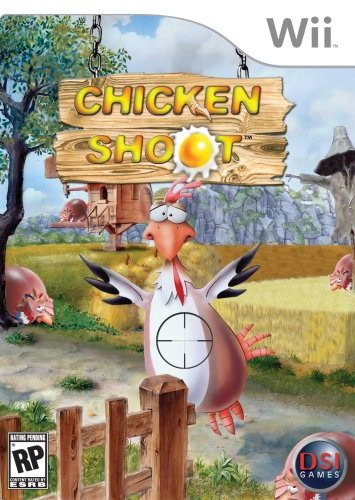
shootsucks.jpgWhat if someone insists Chicken Shoot is a better shooter than Metroid Prime 3 simply because s/he liked it more? Are we actually willing to grant the subjectivist claim in these situations, in which even a hardened subjectivist must acknowledge the approach loses some appeal?

To embrace a subjectivist view of gaming is to award critical merit to any uninformed bargain shopper browsing Wal-Mart’s Wii section, even if s/he thinks Ninjabread Man is more impressive than Twilight Princess.

Fortunately, there is an opposing view, though it may seem a slightly tougher pill to swallow. Objectivism contends value judgments of a given variable can be wrong. Furthermore, an objectivist thinker would also argue there exists not only an incorrect value assessment of a given variable, but also a correct one. Unlike the alluring, all-pleasing simplicity of subjectivism, objectivism takes some fairly controversial positions. It can also be complicated and, quite frankly, can describe two very different positions. In fact, objectivists fall into one of two distinct categories: realists and relativists.

Realists believe there are universal, intrinsic features that determine the value of a given variable and these features alone are the criteria by which something can be considered “good” or “bad.”

This proposition begs an obvious question: what are these intrinsic value features, exactly, and how do we identify them? The realist is admittedly vague, but insists they are the sole means of accurately determining value. In an argument that initially seems preposterous, the realist also claims only a select group of people have senses of value judgment heightened enough to detect these value features.

In other words, some people get it and others just can’t.

The realist defends this position with interesting arguments, asserting these intrinsic value features - the traits that make a given game good, for example - exist in the same way smell, color and taste does, as entirely tangible aspects of the universe. The fact that some are physically unable to detect them, they argue, does not negate their existence. Just as a color-blind person cannot accurately view color and a deaf person cannot clearly distinguish sound, so too exist those with an inability to sense these value features.

Relativists, however, take a very different approach to determining value. Unlike the subjectivists, they feel a person can be wrong about his/her value judgment. But the relativists also disagree with the realist view that value can only be determined by an intrinsic set of value features. Essentially, relativists take the middle road; they maintain value is prescribed not by some intrinsic trait, but by the designation of value through a community agreement.

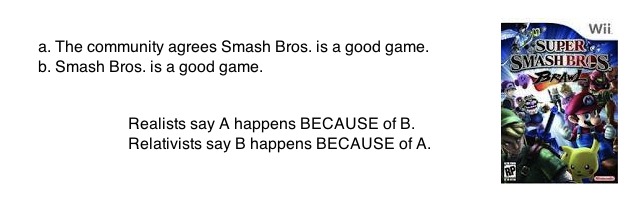
The relativist/realist split is perhaps most clearly explained in the case of Super Smash Bros. Brawl:

rrsplit.jpg

Each of the two objectivist positions face a difficult problem, however.

The realist faces the aforementioned evidential question; color, for example, has a physical story to tell in regard to its judgment, involving light meeting the human retina. But the realists’ supposed intrinsic value features are left with no reliable, physically explainable access. With what faculty do we make these decisions?

Relativists are confronted with a more pressing issue. If asked why a community reaches an agreement on value, their argument could quickly change into to a realist proposition. For the relativist, unless s/he answers that the community decision is completely arbitrary, their argument asserts the community designated something as good because it is good. Their proposition is suddenly rendered obsolete; the relativist would then be supporting a decidedly realist claim.

Like Pit’s Centurion-calling final smash, these pieces of philosophical ramblings bounced feverishly through the corridors of my mind as I quietly chewed my tasty Greek pizza, sipped my crisp, refreshing Cherry Coke and listened to five reasons Assassin’s Creed is the best non-Halo 360 game. I made it to reason three before I interjected.

“Nope,” I quipped. “You’re wrong.”

Surprised looks were shot at me from every direction; I rarely interrupted someone on a ranting roll, understanding full well the value of a healthy pontification. After a second or two of silence, my friend, taken aback, asked me why I felt he was flawed in his leg-humping assessment of Assassin’s Creed.

“Because I am a realist,” I replied. “And you are wrong.”

20 Comments

  1. peshue says...

    I don’t mean to diss your post, because it really is rather well written and thought out. But like a lot of philosophical writing, 75% of it is bs hidden behind unnecessary obfuscation.
    You have a good point though. I think it’s worth mentioning that in large the video game community is a bunch of drooling idiots that value “cool” more than quality.

  2. TS says...

    peshue: And along those lines the community values cool more than quality because there isn’t much quality found in video games. The medium is very immature and younger than some of its oldest consumers.

    However its popularity brings forth more creators who will hopefully test and challenge conventions of popular gaming whether it be though narrative, interface, or design.

  3. Noremakk says...

    Finally, a good long ranting post from someone other than Malstrom! (who I, frankly, disagree with on nearly every point and no longer read what he writes)

    I tend to see things from a roundabout kind of view. Example: SSBB is a good game. Therefore the community agrees it is good. Because the community agrees on it, it must make it good. Which is why the community agrees on it.

    Take a step back from it for a minute, and it’s as messed up as the stock market of international currency. Who is the initial person who declares that a dollar will suddenly be worth less than the Canadian dollar, or that SSBB is the best Wii game ever? I say we track down this person, lock him/her up, and let everyone else formulate their own opinions.

  4. InvisibleMan says...

    Context is very important in evaluating games, I think… I just read an article about how the length of a game used to be a big factor in evaluating a game: if the game is too short (say, four hours of gameplay or so), it is bad. But lately a lot of gamers have found they don’t have the 35+ hours to finish an average RPG, or that they have to divide the gameplay in two-hour installments separated by a month or so between sit-downs. By they time you go back to it, you forgot what you were doing and you practically have to start again, or backtrack considerably. In that context, a lengthy game is a bad game. Subjectivity, right there!

    I’d say that in the specific case of video games, you can’t be a realist. Read the reviews from “experts”, but know that some of the features they find less enjoyable might be precisely what you are looking for in a game…

  5. Blake says...

    Funny read, D.

  6. I)ruid says...

    Cherry coke is so, so good…

  7. deepthought says...

    Empirically speaking, Halo3 sucks. It partakes in the form of suck so strongly, it nealy is suck.

    Also, realists still have reasons. For instance, it can be proven scientifically, mathematically, and metaphysically that Halo3 sucks. Why was your friend wrong about AC though?

  8. Loknar64 says...

    I)ruid hit the topic where it’s really important.

  9. Krist says...

    I wouldn’t say this article was bs, it was just elaborate. It’s a philosophical musing after all.

    For a realist objectivist (like myself) the difficulty lies in defending a game or a piece of art that is -not- popular. How do you argue against a majority opinion? What makes me so special?
    “The masses are the asses” I guess, but it’s hard to maintain that attitude and not sound like an elitist dick…

  10. Tadashi says...

    You are wrong.

  11. Eolirin says...

    I really find it sad that the misuse of the term “begs the question” is so prevalent in our society that someone can be having a high level philosophy discussion and so horribly abuse a logic term, one used to define a *fallacy* at that, especially since philosophy and logic are so tightly intertwined. Logicians have *only* been using the term for 2000 plus years, it’s not like the journalists who started this mess should have known about it or anything.

    I also have huge issues with objectivism in regard to art, mostly because realist positions will typically devolve to “I am right for reasons that I cannot articulate, but if you were capable of understanding truth the way I do, you’d agree.” This is useless. Even if the realist is correct in his assessment and there is a higher truth that only he and the people who agree with him can see, it doesn’t benefit anyone except the realist. There’s no growth from discussion since there’s always an appeal to an undefinable higher truth; nothing is learned, nothing is gained, nothing changes. If you’re going to have a useless discussion, you may as well not be an elitist ass about it.

    But you’re mostly right in *this* case. Games are not just art; they’re also craft, and craft *can* be objectively defined. It’s not enough to say that I really enjoyed something if you want to look at the quality of the game. You can very clearly define whether or not a mechanic helps to obtain a stated goal or fits with the other mechanics in the game. The only subjectivity that can occur is in whether or not the goals of the game are “good” or not, something that’s not really worth merit in discussion; it goes no where. If you examine a game for internal consistency it’s very easy to highlight faults or elegance on a completely objective level though. Prime 3 is a better shooter than Chicken Shoot not because more people enjoy it but because it’s better at being a shooter and I can very clearly point at why. The controls, level flow, enemy design, are all objectively better, even divorced from surface layer of the artwork and fictional elements. You can very clearly measure all of those things; there’s no guesswork involved, no vagueness. Remove the content, examine the mechanics, and objectivity is easy to find. This is no different than examining a movie based on it’s cinematographic strengths, or music based on principles of harmony, it’s just that games don’t yet have the same sort of defined language for analysis that other mediums do.

    This says nothing about whether the game is fun, or even valuable, of course. Only whether it’s well built. But that really is as it should be.

  12. InvisibleMan says...

    Good point, Eolirin…

    There is an objective way to rate a game as there is an objective way to rate films, literature, and painting.

    But if you are looking for whether you will have fun with this specific game, objectivity is not enough. That’s when you have to evaluate the context of your particular situation, and be subjective about it.

  13. Eolirin says...

    Yep, much more succinct than my post (I talk too much, heh), but yes, that’s exactly it.

  14. vertol says...

    I’m sure you’re not speaking of Rand’s Objectivism. She believes “Material objects as such have neither value nor disvalue; they acquire value-significance only in regard to a living being—particularly, in regard to serving or hindering man’s goals”, quite dissimilar to the idea of objective value you pose. Rand also says “Values cannot exist (cannot be valued) outside the full context of a man’s life, needs, goals, and knowledge”. It seems to me you are equating an objective theory of value with an intrinsic theory of value, that is to say, the theory that things are good or bad regardless of human opinion.

    The following is another quote from Rand explaining the idiocy of the idea of intrinsic value:

    “If a man believes that the good is intrinsic in certain actions, he will not hesitate to force others to perform them. If he believes that the human benefit or injury caused by such actions is of no significance, he will regard a sea of blood as of no significance. If he believes that the beneficiaries of such actions are irrelevant (or interchangeable), he will regard wholesale slaughter as his moral duty in the service of a “higher” good. It is the intrinsic theory of values that produces a Robespierre, a Lenin, a Stalin, or a Hitler. It is not an accident that Eichmann was a Kantian.”

  15. DocOctorok says...

    Clearly, a game can suck. As proof, I give you the multitude of games out there that suck. This was famously argued by the 17th century gaming philosopher René Descartridge when he declared, “Suckito, ergo suck (I suck, therefore I suck)”.

  16. streex says...

    Where did you find this writer? This is poorly written. You need to go back to school.

  17. Run line 10 says...

    Nice post!

    Clearly he and others will hump the leg of AC because of graphics first and then only hope to get a game but the graphics satisfied what they wanted in the first place. They will not say it like that but that is the real reason why they love the game. Or you can add in another aspect of AC and do the same thing. Speaking of realist and Objectivism is only part of the picture. Using those terms will only bring gaming full cirlce into the world of art! Which is a good thing and bad thing if developers start using these things. Many people will come to an amusement park yet they will all look for a certain some thing to do, just like gaming. It is an interactivity activity where the person brings the motivation to the experience. What ever that motivation is it must be satisfied. If it is then the game is deemed good because you got what you wanted. I mean a hearing impaired person can still like a band because they just like how the live performance has so much energy.

    To really understand art you must know art history and go to all the artist talks.

    The logic for what is good depends on so many things and will vary wildly yet the success will depend on which good thing satisfies the largest group.

    Normally a good game can defy logic and hook people which is what you really want to do. Another thing is history will tell you more about gaming than a course. Gaming at the core is built off of the need or want to interact with a program for long periods of time even if that time is broken up into small burst. Then it rely on what type of gamer is out there. Games may suck now if you where a skill based gamer because to have a good story based game people have to actually be able to experience the story right?

    Basically you proposed an argument that he may not be willing to talk about due to the fact that he only likes AC because of the graphics, story or climbing parts. To take part in your argument he does have to be invested in your subject which is philosophy and not really video games. If he doesn’t know what you are talking about or referring to then he may think you where trying to say it was not REAL enough. Nice post though.

  18. Jake says...

    All I can say is wow! Very deep and a good read!

  19. ResidentialEvil says...

    AC is a great game, and you are wrong.

  20. Krist says...

    “If a man believes that the good is intrinsic in certain actions, he will not hesitate to force others to perform them.”
    Doesn’t this assumption exclude the belief that ‘one can’t force his ideals on another human being’ could just as well be considered an intrinsic value? One that believes in intrinsic value will naturally harbour a total disregard for all life?
    I’m not buying that…

Post a comment

Want speed commenting? Login or register to become a FREE member.